How to Get the Most From a Trial Separation

Trial Separation
"An informal agreement between spouses to live separately from each other for a certain period of time without getting divorced."
Your marriage isn’t going well. It hasn't been going well for a very long time. But the thought of getting a divorce ties your insides into knots!
You’re not sure you're ready for a divorce. You might not even want a divorce. (Or, at least you don't think you want a divorce!)
You just want your marriage to change. You want your life to change. Most of all, you want your spouse to change.
But you don't know how to make any of those things happen. You start wondering whether temporarily separating from your spouse will help.
Putting some space between you and your spouse might give you both some room to breathe. It could give you the time you need to figure things out - WITHOUT doing something rash and irreversible (... like getting a divorce!)
At the same time, everything you’ve heard about trial separations is bad.
People say that a trial separation is just the beginning of the end of your marriage. They say it always leads to divorce.
If that's true, and you're going to get divorced anyway, doesn't it make more sense to rip the band aid off and just do it?
The answer of course depends on you and your situation. But in order to answer that question in a way you won't later regret, you need to understand exactly what a trial separation IS and how it works.
Contents
- What is a Trial Separation?
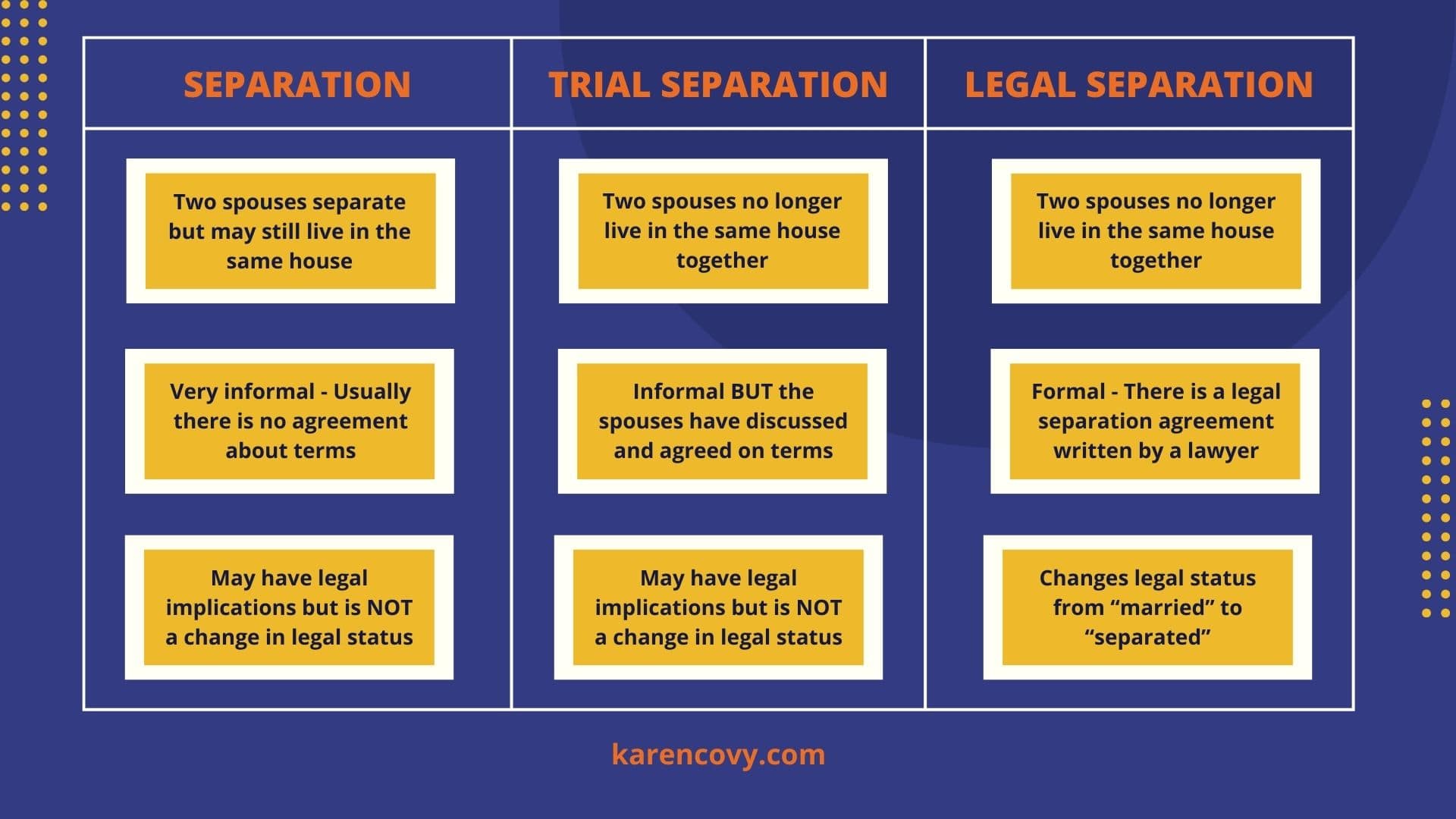
- What’s the Difference Between a Separation, a Trial Separation, and a Legal Separation?
- Does a Trial Separation Always End in Divorce?
- The 3 Essential Elements for a Successful Trial Separation
What is a Trial Separation and What is It For?
The term “trial separation” has been defined as everything from “an informal splitting of a couple.” to “an experiment in living apart.” What a trial separation feels like is the end of your world - or a chance to finally breathe - depending on where you sit.
That’s what makes trial separations so tricky.
Most of the time, only one person really wants to separate. The other person wants to stay together and work things out. That’s why knowing what your trial separation is FOR (i.e. knowing your purpose) is so important.

If you don’t know what you are trying to achieve by separating, you’ll never know whether your trial separation was a resounding success or the biggest mistake you ever made.
To figure out your purpose you need to start by asking yourself some basic questions.
- WHY do you want to separate?
- Why does your spouse want to separate?
- What do you hope to achieve by separating?
- Are you trying to get clarity about what to do with your marriage?
- Are you trying to figure out if you still love each other?
- Or are you just trying to determine if you can live alone?
- Do you really want a trial separation … or do you really want a divorce?
Knowing the PURPOSE of your trial separation (preferably BEFORE you separate) can make the difference between a trial separation that brings you clarity and peace, and one that leads to the ugly divorce you don't want.
What’s the Difference Between a Separation, a Trial Separation and a Legal Separation?
A separation, a trial separation, and a legal separation are all totally different things. Understanding the differences between each type of separation is critical.
What's the difference?
When done right both a separation and a trial separation can potentially save your marriage. At the very least they'll help you get clarity about whether ending it makes sense for you.
A legal separation, on the other hand, effectively ends your marriage, in all but the technical legal sense.
Marital Separation: Definition
A "separation" in marriage can mean a lot of different things. It can mean:
- One spouse moved out of the house;
- One spouse moved out of the bedroom;
- One spouse moved into the basement/attic/other distinct space in the house.
The spouses in a marriage can "separate" at any time, for any reason. The separation can be temporary or permanent. It can have clearly defined rules or no rules at all.
The challenge is that establishing rules and setting boundaries requires you to talk with your spouse. You've got to have hard conversations about topics you'd probably rather avoid. That's why most people don't do that. As a result, their "separation" is a free form jumble of confusion and hurt feelings. For the most part, these types of separations don't go very well.
Trial Separation: Definition
A true “trial separation” isn’t just the thing that happens when one spouse moves out of the house in a huff. A real trial separation is a conscious arrangement both spouses make (hopefully) BEFORE they actually separate.
In a real trial separation, both spouses talk to each other about their expectations. They set the ground rules, establish boundaries, and decide on a time limit for their separation.
Ideally, they put all of that in writing so that each one of them is CLEAR about the purpose, rules, and duration of their trial separation.
[NOTE: Because a trial separation is an informal arrangement, writing down your terms doesn’t require lawyers ... although having someone mediate your trial separation and write down the terms for you can be extremely helpful.]
Legal Separation: Definition
A legal separation is much different. A legal separation is an actual legal change in status. It's much like a divorce, except that it doesn’t end your marriage. It only separates you and your spouse in some legal ways.
In a legal separation, a couple will divide up their personal property. They will make formal agreements regarding when and how they will see and parent their children. They will also agree on child and spousal support. But after they do all that they will remain legally married.
When you're getting a legal separation you will go through a legal process that's very similar to the legal process required to get a divorce. For most people, that means getting a lawyer, filing a petition in court, and going through a lengthy court process that ultimately ends with a judge signing a court order that says you're legally separated.
Trial Separations v Legal Separations
True legal separations are much rarer than they used to be. That's because the reasons for getting a legal separation aren't as compelling today.
In the past, legal separations were used by spouses who needed to stay married for one of two reasons:
- To stay on their spouse's health insurance; or
- For religious reasons.

Today, getting a legal separation usually doesn’t make a lot of sense. Getting a legal separation is just as complicated and expensive as getting a divorce ... but you're still married. That means you can't marry anyone else. If you ever want to do that, you still need to get a divorce.
What’s more, most health insurance companies today generally won’t let separated spouse sstay on the same insurance policy if they're legally separated. So, unless you are avoiding divorce for religious reasons, getting a legal separation usually doesn’t make sense.
Does a Trial Separation Always End in Divorce?

Trial separations get a bad rap.
Lots of trial separations, maybe even most of them, ultimately end in divorce. But that’s usually because the person who says s/he wants a trial separation really wants a divorce. S/he just doesn’t have the guts to tell his/her spouse that their marriage is over.
So, instead of being honest, the spouse who really wants a divorce suggests having a “trial separation" instead.
Not surprisingly, that kind of trial separation usually does end in divorce. That couple’s marriage was over long before they separated. They just weren’t ready to sign the death certificate.
Trial separations between couples who need some time apart to work on their marriage, however, can have a much different result. Those kinds of trial separations can actually strengthen a marriage – especially if the couple gets the right professional support to help them along the way.
If you manage your trial separation properly, it can actually lay the groundwork for a better marriage or an amicable divorce. On the other hand, if you make a botch of your separation, you can set your marriage on the course for an ugly divorce before it even starts.
Considering separating but not sure how to do it?
Get your FREE Trial Separation Checklist now.
The 3 Essential Elements for a Successful Trial Separation
Essential Element #1: HAVE GOALS
If you think you’re separating to work on your marriage, but your spouse thinks you’re separating so you can figure out how to live apart, you clearly don’t have the same goals!
Knowing your goals, and doing your best to agree with your spouse about the purpose of your separation, is critically important. If you don’t do that, you risk dooming your trial separation from the start.
So, how do you agree on your goals? You start by deciding what you want and talking about it with your spouse. You talk as openly and honestly as you can about what you want and why you want it.

What happens if you and your spouse CAN'T agree on your goals?
Unfortunately, there's not much you can do in that situation.
You can't force your spouse to share your goals. You can't force your spouse to want the same things you want.
But if your spouse wants a divorce and you don't (or vice versa), if both of you can at least be honest about what you want then both of you can start coming to terms with the reality of your situation.
Lying about your goals just to avoid conflict is what makes so many trial separations go off the rails.
Essential Element #2: ESTABLISH RULES
One of the main things that differentiates a true trial separation from one that’s an unofficial divorce in disguise is: RULES.
Real trial separations have rules. Ideally, they have written rules. Those rules ensure that both spouses are totally clear on what each of them can and cannot do during the separation period. The rules define the trial separation.
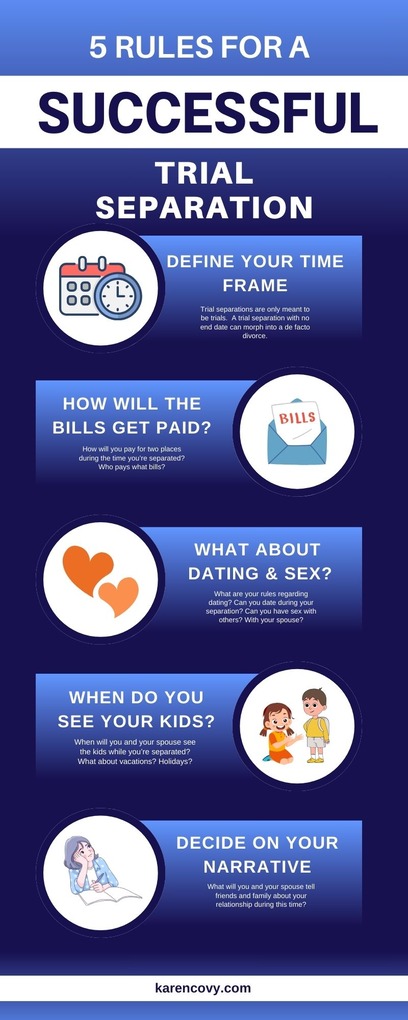
Here are twelve rules you need to think about if you want your trial separation to work.

Ground Rules for a Successful Trial Separation
1. Have a clear end date.
Trial separations are meant to be exactly that: trials. They are meant to be a time during which a couple works on figuring out whether to stay together or split for good.
In order to keep your trial separation from morphing into a de facto divorce, you’ve got to put a limit on it.
Most trial separations run for about six months. If you’re apart too much longer than that, your chances of ever getting back together diminish enormously.
2. Figure out your living arrangements.
Obviously, if you and your spouse decide to separate, someone is going to have to move out. You need to figure out who that will be and what "moving out" means. Is someone moving out of the house ... or just moving out of the bedroom?
If someone is moving out of the house you need to decide the rules surrounding access to the house. Can the person who left still come and go as s/he pleases? Since both you and your spouse still own (or lease) the home together, the spouse who left may still feel like that’s his/her home, too. But, then what about the staying spouse’s privacy?
It helps to set out the house rules on the front end.
3. Decide how you will pay the bills while you’re apart.
When you’re living apart, you’ve still got to pay all of the marital bills, plus the bills for a second home, utilities, food, etc.
How are you going to do that? Who is going to pay for what?
If you don’t set rules about paying the bills from the beginning, your trial separation can turn into a full-blown divorce really quickly!

4. Set your spending rules during the trial separation.
Paying the bills isn’t the only financial issue you have to think about when you separate.
What if one of you wants to take an expensive trip to some exotic place while you’re living apart? S/he will still be using marital money to pay for the trip. Does that mean that the other spouse gets to take the same amount of money out for something for him/herself too?!
What if one spouse runs up a huge credit card bill? It’s wise to set limits on your spending from the beginning before you create long term financial problems.

5. Establish clear rules about dating during your trial separation.
If you want to work on your marriage then dating other people while you're separated doesn't make sense. Dating other people during your trial separation can make your struggling marriage totally flat line.
On the other hand, since you and your spouse will be living separately for a while, one of you may assume that dating others is part of your deal. That's why you and your spouse have to talk about the rules surrounding dating others.
What's more, you MUST be on the same page about this. If one of you thinks dating means your marriage is over and the other person starts dating anyway, any bit of trust and goodwill you had with each other will be blown. So you NEED to talk about this and you NEED to understand and be okay with the way each of you feels about dating others during your separation.

6. What about sex? (… with each other and with others.)
Dating other people is one thing, but sex takes dating to a whole new level.
Having sex with third parties can potentially affect your spouse’s health. It also dramatically increases the chances that one of you will form a more serious relationship outside of your marriage. Once that happens, putting your marriage back on track will be next to impossible.
Don't assume that just because YOU would never dream of having sex outside your marriage that doesn't mean that your spouse feels the same way! You may be surprised to discover that you and your spouse have very different definitions of what “dating” during your trial separation means.
Finally, even if you and your spouse agree not to have sex with others, what about having sex with each other? Can your spouse still have sex together while you're separated? You may not be sure of your answer right now, but it's still worth having a conversation about the question.
7. Set a schedule for when each of you will see the kids.
Once you and your spouse separate, you can’t both be with your kids all the time anymore. You’re going to need a schedule for when each of you sees the kids.
Look at your schedule for the next six months (or whatever time you have agreed on to be separated). Talk about when you will each see the kids on a weekly basis. Talk, too, about how you will handle any holidays or vacations that come up while you are separated.
(HINT: If you want to give your kids a feeling of security and stability during this period, make sure that you also let them know in advance what their schedule is going to be!)
8. Decide how you're going to parent your kids during your separation.

Making a parenting schedule is only one small part of parenting your kids.
You and your spouse need to agree on what you are going to tell your kids about your separation. You need to talk about how you will make major decisions about your kids, and how you will handle the issues that come up with kids while you're separated.
You also need to be clear about how you'll decide what activities the kids participate in and how you make medical and education decisions for them during this time.
Finally, you need to decide what you're going to tell your kids about your separation. Trial separations can be confusing and stressful for children - especially if they have no idea what's going on. When you or your spouse moves out your kids WILL have questions. Knowing how to answer those questions - and having the same answer as your spouse - will make this transition much smoother and easier on your kids.
9. Set rules for how (and how often) you will communicate with each other.
This may seem like a silly thing to waste your brainpower on. But, if you have kids together, you and your spouse WILL need to talk about scheduling, kid issues etc. Deciding how that communication will occur in advance can save you from a lot of misunderstandings and arguments later on while your separation is in place.
For example, if you think you’re separating so you can get some space to think, you may not want your spouse texting you 24/7/365!
Or, you may be okay with texts, but you don’t want calls. Or maybe calling is okay, but "just dropping by" to visit isn't okay.
You and your spouse can make whatever kind of communication rules that you want. There is no one "right" way to communicate with your spouse while you're separated. What’s important is that you talk about how you'll communicate and you decide what's going to be best for you and your spouse during this time.

10. Get professional help while you’re separated.
You don’t need to go to couples counseling just because you and your spouse separated. But, if you want to dramatically increase the chances that your trial separation will end in reconciliation, you will. (Getting an individual therapist wouldn't be a bad idea either!)
Also, you might want to talk about whether it’s okay to talk to a divorce lawyer or a financial planner during this time. You may think talking to a divorce professional at this point is wise. Your spouse may think it’s a sign that you have no faith that your marriage will ever work out.
There is no right and wrong way to handle all this. What matters is that you and your spouse talk about it so that you eliminate as much miscommunication as possible.
11. Decide what you will (and won't!) tell your friends and family about your separation.
Unless you live thousands of miles from all of your friends and family, someone is going to notice that you and your spouse are no longer living together.
If you tell an inquiring friend that you and your spouse are “just taking a breather,” and your spouse tells that friend that s/he is now “almost single,” you’re going to have a problem! (And, not just with your friend!)
Take the time to write a short “elevator speech” that both you and your spouse can get on board with right now. That will make answering questions later a whole lot easier.
12. Decide in advance what will happen if someone breaks the rules.
You can have all the rules you want, but what are you going to do if you or your spouse breaks one?
Does it matter which rule someone broke? Will you agree to talk about what happened before anyone does anything rash? Or, will breaking a rule be the last straw that ends your marriage?
Again, there are no right or wrong answers. What matters is talking about the questions, preferably before you’re in crisis.

Essential Element #3: FOLLOW THE GOLDEN RULE
Having rules for your trial separation sets you up for success. But following the Golden Rule is what will truly seal the deal. In other words: Do unto your spouse as you would have him/her do unto you.
What does that mean?
1. Be Honest.
All the rules in the world won’t matter if you just B.S. your way through them. If you really want to see if you can save your marriage, then being honest is non-negotiable.
If you don’t care about saving your marriage, that's fine. But do everyone a favor. Be honest about it.
Forget about a trial separation. Just get divorced.
I mean, seriously. What’s the point?
Of course being honest with your spouse can be rough – especially if you haven’t had the courage to be honest for a long time. (Or ever!)
Being honest takes work. It takes guts. It may even take professional help. (Hence, another reason to get a therapist! or a good divorce coach!) But it is an absolute must if you want your trial separation to be anything other than a ginormous, painful, waste of time.
One more thing. Being honest with your spouse isn't enough. You have to be honest with yourself, too.
You may have been telling yourself for years that, even though your marriage wasn't working, if you just hung in there long enough it WOULD work out. Or, maybe you convinced yourself that you “should” want to save your marriage even though, you've known for a while that you just want out.
Whatever the truth is, now is the time to face it. In the end, that’s the only way you’ll ever create a marriage (with your sposue or with anyone else) that’s worth saving.
2. Be Patient
Figuring out what to do with your marriage - especially if you've been married for a long time - takes time! Sometimes, no matter how many ground rules you set, your separation drags on for way longer than you want. Living through that can be rough.
No one likes living in limbo. Yet, sometimes, limbo can actually serve you.
For example, if your spouse needs time to adjust to the idea of divorce, then having a long"ish" trial separation can be a good thing. Pushing your spouse to divorce too quickly usually backfires. It makes your spouse dig in harder. Then your divorce takes longer.
The same thing is true if you're working on your marriage and things are still too "up in the air" to move back in together. Rushing back into your relationship before you're ready can doom your marriage to failure.
On the other hand, while you want to be patient, you don't want to be so patient that your "trial separation" becomes just another place where you get stuck.
The bottom line is that you probably need to be more patient than you think. But you also need to know your limits.
3. Be Kind
Going through a trial separation is hard. Even if you're the one who wanted it (and especially if you WEREN'T the one who wanted it!), separating from your spouse is hard! Extending a little kindness to yourself AND your spouse during this difficult time can go a long way.
Kindness toward each other will make getting back together more possible. It will also make having an amicable divorce more doable.
So, before you act, or react, in anger, frustration, or despair to anything your spouse does or doesn't do: Stop. Take a breath. And ask yourself if what you're about to do is kind.


The Bottom Line
When used correctly, separating from your spouse can be an amazing tool. You can use that tool to work on your marriage or set the stage for an amicable divorce. You can use it to maintain a legal marriage, but separate from your spouse in most other ways.
But to get the most out of a separation you must:
- Understand what a separation is and what you want to achieve by separating;
- Consciously choose the kind of separation that will work FOR you
- Structure your separation in a way that's designed to meet your goals.
Doing that isn't always easy. But in the end, it will absolutely be worth it.
________
This post was originally published in January, 2017 and updated on September 29, 2024.
Considering separating but not sure how to do it?
Get your FREE Trial Separation Checklist now.
About Karen Covy
Divorce Coach, Decision Coach & Lawyer
Karen Covy is a divorce coach, decision coach, and lawyer who has been helping people navigate through divorce for over 30 years. She is the author of "When Happily Ever After Ends" and the host of the Off the Fence podcast.
Learn more about KarenReady to Take the Next Step?
Get personalized guidance to navigate your divorce with clarity and confidence. Schedule a free consultation with Karen today.